

First of all, let me clarify, this blog post isn’t going to discuss the latest fallings out or who has a crush on who. No, I don’t mean that kind of drama (we have enough of that already in our classrooms!). This blog is going to be about Drama (the subject) which is (in my opinion) the greatest tool a teacher could use in their classroom.
When someone mentions Drama, there are three types of teachers.
There are teachers who are fascinated by Drama and really want to explore the possibility of using drama in their lessons. They visit a Drama lesson and see students running around, shouting their heads off and suddenly have second thoughts.
Then there are the teachers who completely avoid drama like it’s the plague. They believe that allowing students out of their seats is a one-way ticket to complete ruin. “We must keep them imprisoned behind their chairs to restrict movement and avoid disorder!”. We all know these kinds of teachers…
Last, but definitely not least, there are teachers like me, who absolutely love it. We see the incredible benefits that Drama can bring to our classroom, how it can enrich our student’s education and how it can give students an opportunity for a well-rounded education.
So, which teacher are you?
If you are like me, welcome! Here we are going to learn how to help others open their eyes to the wonderful powers of Drama (I tried not to make that seem like a cult…). If you are one of the other types of teachers, I’m here to open your eyes to the wonderful powers of Drama (no, it definitely sounds like a cult!).
If you’re a teacher who’s a little curious about incorporating Drama in your classroom, what’s been holding you back? Let’s face some truths: Yes, Drama can get quite lively, and yes, it might seem a tad chaotic at times. However, it’s a structured form of chaos and that excitable noise you hear? It’s the sound of genuine and pure enthusiasm from the students. Ready to try? Here are some top tips on how to successfully implement Drama into your classroom:
- Lay down the law
Whenever you attempt any sort of activity that is exciting (and Drama is super exciting) you need to explain your expectations to your students. Make sure they understand clearly what is expected of them and where the boundaries are.
2. Decide on a non-verbal cue
With your students, decide on a non-verbal cue so you can get their attention when needed. A good one (that I have used for years) is putting your hand in the air. When you do this, students stop what they are doing, put their hand in the air and look your way. This then allows you to get their attention quickly and give instructions without shouting over them.
3. Space
If you need to move tables and chairs in the classroom, explain how this is going to be done. Train your students to move equipment safely or have a plan in place. I have successfully taught Drama in a normal classroom setup and students knew exactly what was expected of them when setting up and tidying away (so students are trainable!).
4. Games
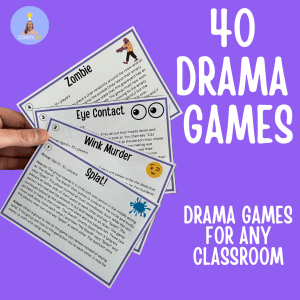
If you want to start introducing Drama into your classroom, Drama games are an amazing way to do this. Drama games aren’t just extremely fun, they are also very beneficial for social skills such as collaboration, communication and confidence. Don’t know any Drama games? I’ve got you sorted! I created a Pack of 40 Drama Games for any classroom. Just choose one and play! Easy as that.
5. Using Drama with any topic
Whether it’s History, English or Science, Drama can be used to bring boring topics to life. Now, I’m not saying that all other subjects are boring but, as someone who taught English, I know there are some very dry topics which could benefit from a bit of spice. For example, (instead of just reading about it) in History, students could act out a pivotal moment in history or in Science students could practically explore the process of a caterpillar turning into a butterfly. The options are limitless!
Take the leap, follow the top tips and I promise you, you’ll look around your classroom and see your students completely engaged and immersed in their work, having fun and practicing key life skills. Bring learning to life through Drama!

 Schooled Resources
Leave a reply to What are Drama Circles? – Schooled Resources Cancel reply